

Should we accept what History has passed down, or does it behove us to question what we have been told.
If you have visited the Veneto on Italy or innumerable buildings in Britain that boast of a ‘Palladian’ influence, you will have come across the work of Andrea Palladio, living in sixteenth century between 1508 and 1580. He is often described as the greatest architect of 16C Italy and one with enormous influence. The buildings attributed to him include this one, the Rotunda, just outside Vicenza:
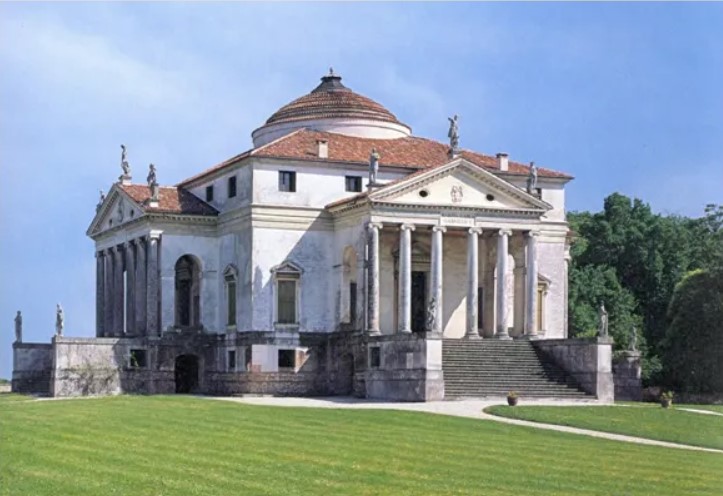
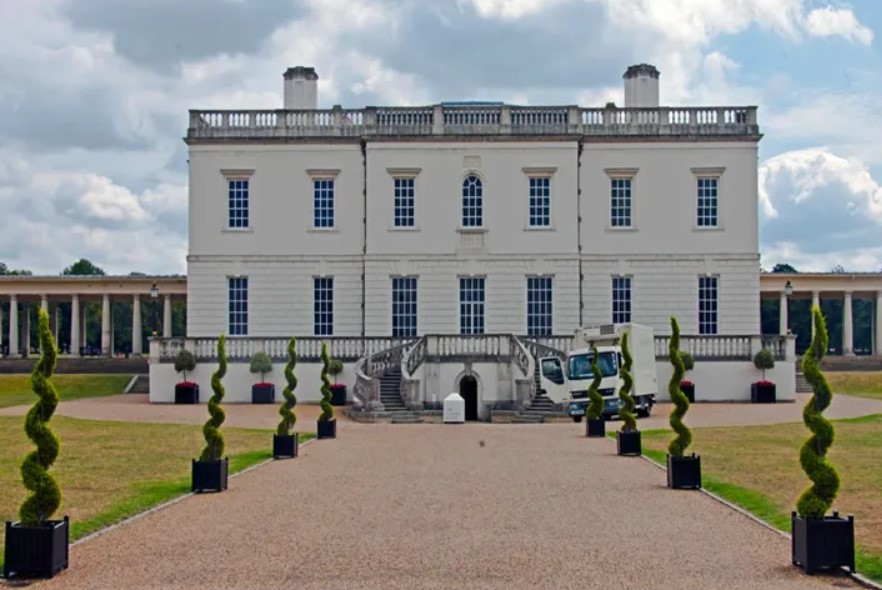
This building was allegedly the inspiration for later buildings including those by Inigo Jones in 17C and by Lord Burlington in 18C in England. Here by way of eample is Inigo Jones’ Queen’s House in Greenwich, influenced according to the Royal Museums, Greenwich, by Palladio:
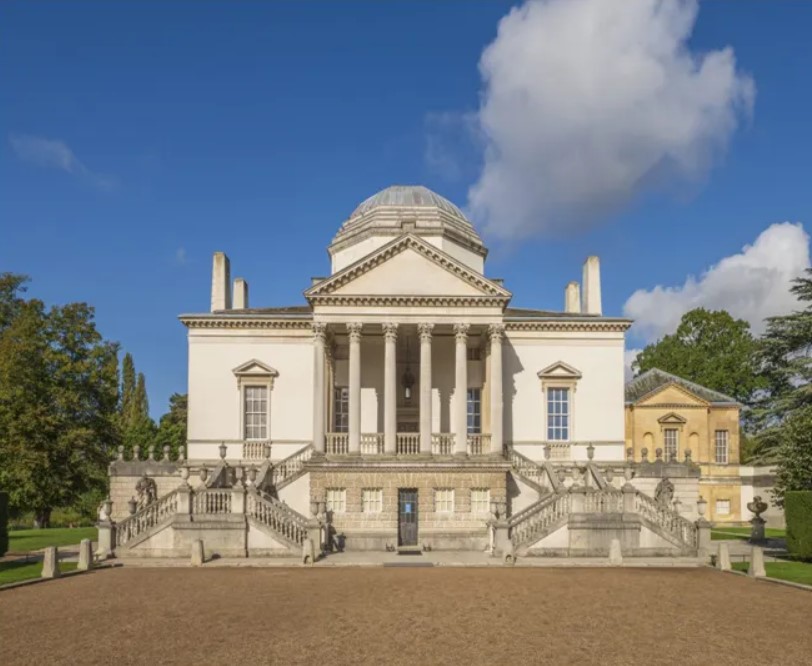
And here is Chiswick House, the work allegedly of Lord Burlington and a ‘Palladian marvel’ according to the House’s official website:
Well, the visual connections can be discerned but is the history as robust as we might have hoped? In order to answer this question, and at the risk of offending oficianados of architecture, we delve into the history behind Palladio, Inigo Jones and the third Earl of Burlington.
Palladio
Would you be surprised to learn that this was an acquired name? The son of a miller, his name was originally Andrea di Pietro della Gondola and it was only later that he received the name Palladio. Until that time, he was apprenticed – we are told – to a sculptor and then, at the age of 16, moved to nearby Vicenza, enrolling in the bricklayers and stonemasons guild. He was then employed as a mason in workshops specialising in monuments and decorative sculpture and was only introduced to architecture while working as a mason for the humanist scholar and poet Count Trissino. His ‘training’ in classical architecture consisted, we are told, of several visits to Rome. And we learn that the name by which he is known, ‘Palladio’, derives from a character in one of Trissino’s poems. That name references the Greek goddess of wisdom, Pallas Athena, leading Andrea to be subsequently known by that name.
Believable? Well, there are three factors that might give you pause to question whether the man known to us as ‘Palladio’ is any more real than the character in Trissino’s poem. Firstly, the fact that none of the histories provide any details of his personal life. Second, the emphasis on his employment as a mason. And thirdly, the fact that details of his training in architecture are simply absent and without that, how could we rely on the buidings that are attributed to him being creations of his hand.
In fact, there is a fourth factor that might cause Critical Thinkers to question the veracity of this account. It is that the name of another great cultural icon, Shakespeare, may also derive from the goddess Athena, thereby casting doubt on ‘Shakespeare’s authorship of the 39 plays attributed to him. Interestingly, what we learn is that Athena, the goddess of wisdom, War and the Liberal Arts was usually represented with her right hand holding a spear to strike at a serpent near her feet. The consequence is that she was known as the spear-shaker among the ancient Greeks. If the man known as ‘Shakespeare’ was not the author of the plays, was Palladio any more the creator of the 32 villas, 23 magnificent Palaces and the imposing Venetian Church of San Girogio Maggiore, all attributed to him?
Shocking though this may appear, our questioning of history cannot stop at Palladio. For, they must extend also to two other men said to have adopted his style in the buildings attributed to them. These are the figures of Inigo Jones and the 3rd Earl of Burlington. Let us now turn to these two celebrated names.
Inigo Jones
Would you be surprised to learn that “almost nothing is known” about the “early life or education” of Inigo Jones, despite his being, as we are told by the BBC “the first notable English architect, responsible for introducing the classical architecture of Rome and the Italian Renaissance to Britain”? We are informed that he was born in Smithfield, London, the son of a clothworker, and that after being a designer of court masques, his life took a new direction.
Details are taken here from a gov.uk website:
“In 1614 Jones began a year-long trip through Italy with the Earl of Arundel, resuming his studies in Italian architecture. On his return he was made Surveyor of the King’s Works, responsible for maintaining the King’s palaces and designing and overseeing the construction of new buildings. Today he is best-known for the Queen’s House, Greenwich (1616-40), and the Banqueting House.He travelled to Italy, where he studied architecture and was influenced by the works of Andrea Palladio and other Italian Renaissance masters.”
Explanations of Inigo Jones’ drawing skills (allowing him to create 450 drawings of scenery and costumes) and subsequently architectural skills, are all laid at the door of two trips overseas. The first, allegedly, some time before 1603, was courtesy of an unidentified, rich patron, impressed by the quality of his sketches. His travels took him from Italy to Denmark where he worked – as you do after a grand tour of Italy – on two palaces. Then, 1613 saw him embark on a second trip to Italy, this time with the Earl of Arundel. A mere two years after this, in 1615 he was appointed Surveyor-General of the King’s Works. All just in time for him to begin work on the Queen’s House, Greenwich, a building influenced by none other than Palladio. Work on Banqueting House followed swiftly in 1619.
One clear thread linking the man known as ‘Palladio’ to Inigo Jones was their emergence as ‘architects’ shortly after a tour overseas for you will recall how Palladio, his talent spotted by a patron, acquired his architectural skills on visiting Rome. Now in 2026 when a training in architecture takes around seven years, and a further five years in an architect’s practice following registration, we might be astonished, if not incredulous, to believe that the skills to create elaborate buildings such as the Banqueting House can be achieved from a visit overseas, supplemented by consulting a weighty tome on architecture. This, however, is what history would have us believe.
The metamorphis into an architect following a period overseas accompanies two other famous names. One is Sir Christopher Wren – purportedly “the greatest English architect of his time” – who travelled to Paris in July 1665, remaining there nine months. Strangely, even though he was an astronomer and mathematician by background, he was allegedly the hand behind Oxford’s Sheldonian Theatre, begun in 1664, and Pembroke College Chapel, begun in the previous year. Regrettably, there exist “no drawings in Wren’s hand, no letters and no building accounts”. All that can be found among thr Chapel papers is a drawing “awkward in execution” and a document in Wren’s hand ordering the supply of black and white marble for the floor of the chapel. Could this perchance have been the totality of his involvement?
The book The Dark Side of Academia: How Truth is suppressed has questioned Wren’s active involvement as an architect, with even St Paul’s Cathedral website acknowledging that he may have created no more than 10% of the accumulated drawings for the building, so we have good reason to question.
With the grand European tour, offered up by historican as a proxy form of architectural training in the case of Palladio, Inigo Jones and Wren, let us turn now to the final figure undertaking the grand tour, the third Earl of Burlington.
Earl of Burlington
Chiswick House in West London is a resplendent white building (see image below), with the exterior designed, so we are told, by Richard Boyle, third Earl of Burlington. He completed the building in just three short years from 1726 to 1729, in turn just seven years following a trip to Italy in 1719. The architecture of Palladio was. we are told, a point of particular interest, causing him to return to England with a formidable collection of Palladio’s original drawings. These were supplemented, according to architectural historian Mary Chisolm, by those of Inigo Jones, the architect who,in her view “had first introduced Palladian ideas to England a century earlier.”
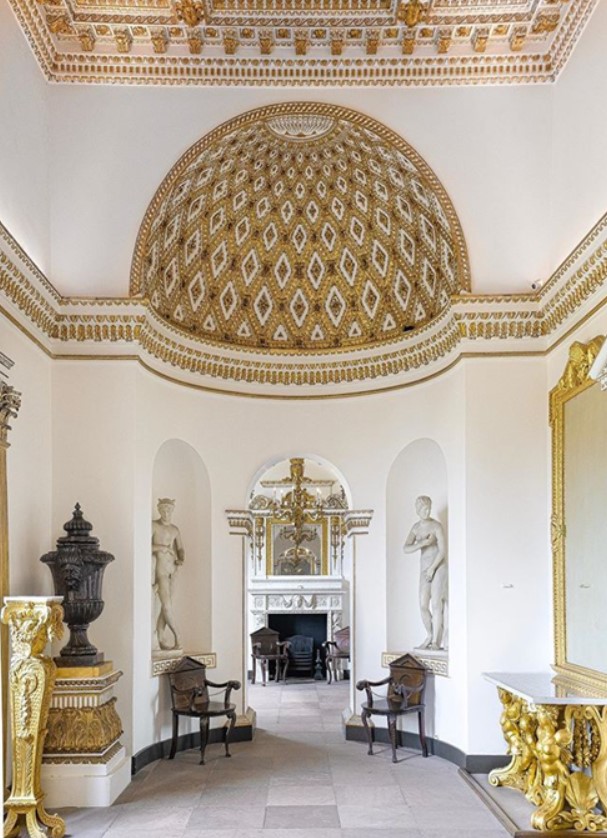
The function of this building? We are told that Burlington wanted an extravagant space for his artwork collection and a place to entertain and impress guests. How likely is it that this was the function of this building? We say this since there was no kitchen and no bathrooms/ toilets for example. As to the lavish and finely crafted interior, English Heritage indicated that this was the work of William Kent, a man who purportedly combined the skills of a painter, architect, garden designer and furniture maker. Can we really believe that a man with so diverse a range of skills could have executed the exquisite interiors shown below?
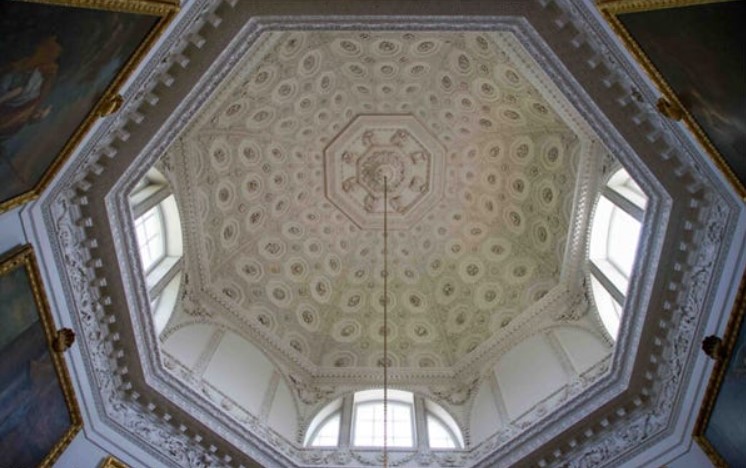
Unanswered questions
A Critical Thinking approach shows how much about the cultural history of Palladianism is open to doubt. We know virtually nothing about the personal history of the man who is said to have given birth to Palladian architecture and have seen that even his name was not that given to him at birth but one based on that of the Goddess of the Liberal Arts, Pallas Athena. What is more, he is said to have acquired his architectural skills by osmosis, by simply visiting Rome. What is more, his oeuvre is unimagineably large and his buildings complex. Here is just one of his palaces and we are to believe that he built 23?
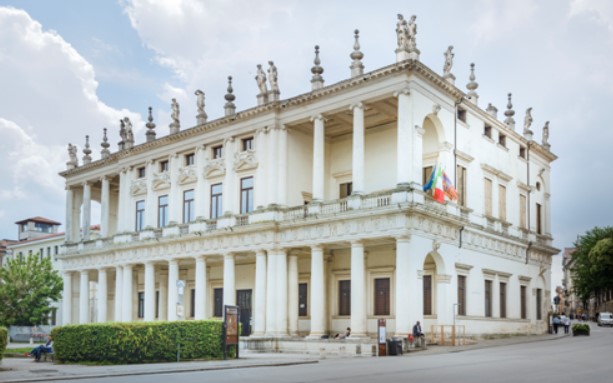
Similar points could be made concerning Inigo Jones,Wren and Lord Burlington, namely that the architectural skills they possessed were acquired simply by travelling overseas. Given the obvious complexity of the buildings credited to them, this is not a credible explanation of how they acquired their extraordinary skills.
We are left with one possibility. This is that the buildings credited to Palladio, Inigo Jones and Lord Burlington were the work of another civilisation, and one that built in a similar style in different countries. This would explain the similarities in buildings as between Italy and England, without needing to resort to arguments about how, say Lord Burlington, encountered buildings by Palladio.
Given what we know about Tartarian civilisation, one that we discussed previously in relation to Garden Cities and Crystal Palaces in England, could it be that what is now described as Palladian architecture was an offshoot of this earlier but concealed civilisation? We can never be certain of the answer but asking questions can allow us to discern uncertainties and anomalies.
