Cassandra Wise, Truth University Press, 2026
Secrets encoded in literary and artistic masterpieces
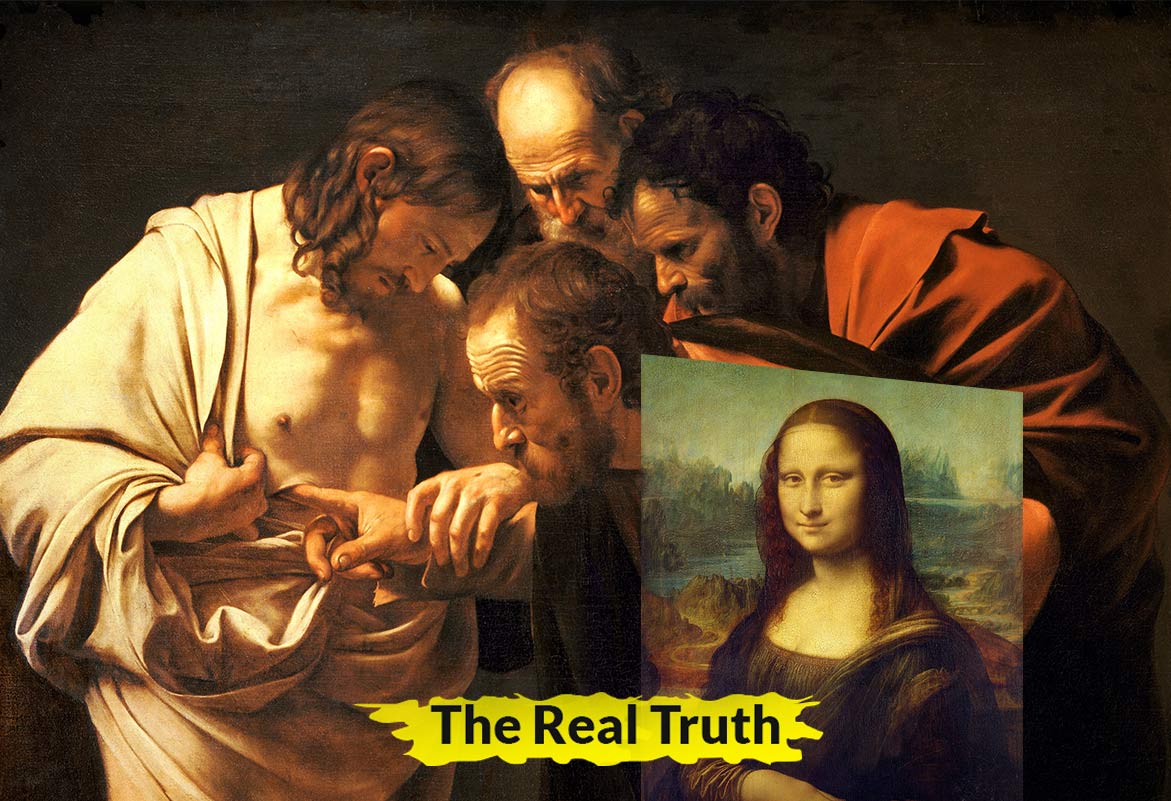
What do literary and artistic masterpieces such as Chrétien de Troyes’ Cligès and Perceval, Bocaccio’s Decameron, the Mona Lisa by Leonardo da Vinci, Caravaggio’s Doubting Thomas, Macchiavelli’s la mandragola, Shakespeare’s Romeo and Juliet and Hans Christian Anderson’s Snow White all have in common? They all reveal a secret belief that Jesus did not die on the cross, escaping death on the cross through taking an anaesthetic drug. This does not detract from his story but confirms that his was a living resurrection, a custom practised since Egyptian times to facilitate spiritual enlightenment and not an ordeal involving death.
In this way, the literary and artistic masterpieces listed above call into question Christian doctrine post Council of Nicea in 325 AD and leave intact the earlier forms of Christianity that prevailed before then. Adherents of the original brand of Christianity, namely the Ebionites, the Nazorenes and the Jewish Christians, would have been branded heretic following the Council of Nicea that codified Christian belief, and strengthened the power of Emperor Constantine, who convened the Council, in the process.
Identity of the anaesthetic drug
The identity of the anaesthetic drug has until now remained a tightly guarded secret, known to the Knights Templar and then passed on through the ages, with writers and painters encoding its existence in stories that feature a potion, being put in a tomb and then rising three days later. In periods of history when speaking out would have presaged a death sentence, stories and paintings were the safest way in which to question post-Nicea Christianity. Thus, the
Mona Lisa
, the world’s most valuable painting, insured for $870 million, contains clues that point to its being a concealed depiction of the plant with anaesthetic qualities. This plant was also, as the book reveals, the ‘apple’ featured in the Garden of Eden so its immense value comes as no surprise. It embodies two of the world’s most concealed beliefs.
The hidden world of herbal medicines
The book reveals how Jesus and those around him had access to a secret world of herbal plants that were of immense value, equal to or exceeding the value of silver and gold. Balsam for example which grew in King Herod’s balsam orchards in Jericho, were twice as valuable as silver. Frankincense, myrrh and spikenard were also immensely valuable and all herbal substances with which Jesus was linked. A few days before the crucifixion, for example, at Bethany, Mary accidentally applied a pound of spikenard to Jesus’ feet (extraordinary given that its value was equal to a labourer’s salary for a year, so c.£36,000 in today’s values) and after the crucifixion, his body was wrapped in 100 pounds of myrrh and aloes. The myrrh on its own would, depending on its quality, have cost anything between £24,000 and £240,000.
The book reveals how Jesus may have been closely connected to the Essenes, one of the three main groups of Jews in the 1C, and the book explores their site of Qumran by the Dead Sea, close to which the Dead Sea Scrolls were discovered. Fascinating investigations reveal, contrary to mainstream knowledge, that the Essenes were running a health centre here using hydrotherapy and herbalism, with exciting analogies with practices at Greek Asclepian healing centres that may have been covertly using anaesthesia. The success of their practice and their use of precious herbal substances, many of which they may have cultivated, explains the scale of the treasure recorded in the Copper Scroll which has been estimated to have a modern-day value of £2.5 -£3.2 billion. So inconvenient is this scroll that academics have dismissed it as fantastical, or postdating the time of Jesus. However, the vast wealth recorded here is consistent with a group who were providing healing using extraordinarily valuable herbal substances.
The finding that the Essenes (a word deriving from the Aramaic ‘assaya’ meaning ‘healers’) were involved in healing makes sense of hitherto unexplained evidence. For example, madder dye was found in the bones of all the corpses in the cemeteries at Qumran and nearby sister sites and this dye is from a plant that is a member of the quinine family, one with multiple medical applications. Then the so-called ‘scroll jars’ found in nearby caves, were twice the height of the scrolls found alongside them (only a few were actually found inside the jars) and, with their air-tight lids, may have been created to store precious herbal substances rather than scrolls.
The knowledge that the Essenes were using vastly precious herbal substances would also explain the powerful tower at the entrance to the site, with a glacis (as in nearby Ein Gedi that was known to produce balsam) to keep the temperature to a constant level. Moreover, the structures labelled ‘tables’ in the so-called ‘scriptorium’ may in fact have served as beds since they have concave sides and a raised area for the head, a structure identical to the couches or benches found in the Asclepian medical centre at Corinth. So, these structures, presented to us at the site as having been tables on which scribes sat and wrote the Dead Sea Scrolls (impossible since scribes then sat cross-legged with the parchment over their legs) probably had a completely different function. One ignored by the mainstream despite many articles on this topic by Gloria Moss.
The fact that the Essenes were knowledgeable in medicine; had close links with Jesus and had bases by the Dead Sea, an area within striking distance of Bethany and Jerusalem, would have given Jesus access to the precious herbal substances with which he is associated in the New Testament. Moreover, the numerous ports and signs of water communications around the Dead Sea would have allowed the Essenes to travel across the waters to the Eastern borders of the Dead Sea where a special variety of the anaesthetic plant grew. Note that many of the surviving columns at these ports have elaborate ornamentation, providing a welcoming environment perhaps to travellers seeking healing from afar.
Knights Templar secrets
It seems that the Knights Templar uncovered documents in Jerusalem and brought these back to Champagne, in France, from whence they were disseminated in Chrétien de Troyes’ novel Cligès that recounts how the beautiful Fenice (a word that translates into phoenix, the Christian symbol of Jesus) escapes from an arranged marriage by taking a potion that gives her the appearance of being dead, then being put in a new tomb, and three days later, uniting with her ex-husband’s nephew, Cligès. Chrétien’s account is littered with allusions to the New Testament resurrection story making his story a heretical one by the standards of post-Council of Nicea Christianity. One of his other novels was dedicated to Marie de Champagne who ran the 12C court in her Templar husband’s absence and subsequently following his death, and she clearly pushed the boundaries of theological thinking by having parts of the Bible translated into the vernacular language, French. What is more, Knights Templar on their way out to Jerusalem, and on their return, would swear to protect the ‘Great Secret’. A high proportion of these Knights Templar were closely connected to the Champagne area of France.
Secrets of the ages finally revealed
Until this day, the nature of this secret has not been revealed. Now, however, for the first time in history, this book reveals the true nature of this Great Secret and shows how it uncovers the 18C secret encoded in the monument at Shugborough Hall, as well as that decipherable through the church and ciphers at Rennes-le-Château in the Languedoc, the mysterious location at which the poorly-paid priest, Bérenger Saunière, suddenly came into immense wealth. All these codes can be deciphered wth the name of the anaesthetic drug.
Getting your copy
The book can be purchased through Truth University by transferring the sum of £19.99 for the book and £3 postage (making a total of £22.99) to the following account: Account number: 66606837 Sort code: 51-50-11. When making your payment, please add your name as the reference and email us at infotruthuniversity@protonmail.com to let us know that you’ve made the payment and giving us the best address for delivery. We can then confirm safe receipt of payment and arrange delivery straight away. Please also email this address with any queries.
Should you wish to purchase a second Truth University book. Lightbulb Moments and the Power of Critical Thinking’, then there is a special deal whereby postage costs are waived, and both books can be purchased for £37. Please go to the ‘Books’ section of the Truth University website (https://truthuniversitycouk.uk/truth-university-press/) where this purchase can be made online using Paypal.
Should you have any questions at all, just email: infotruthuniversity@protonmail.com