

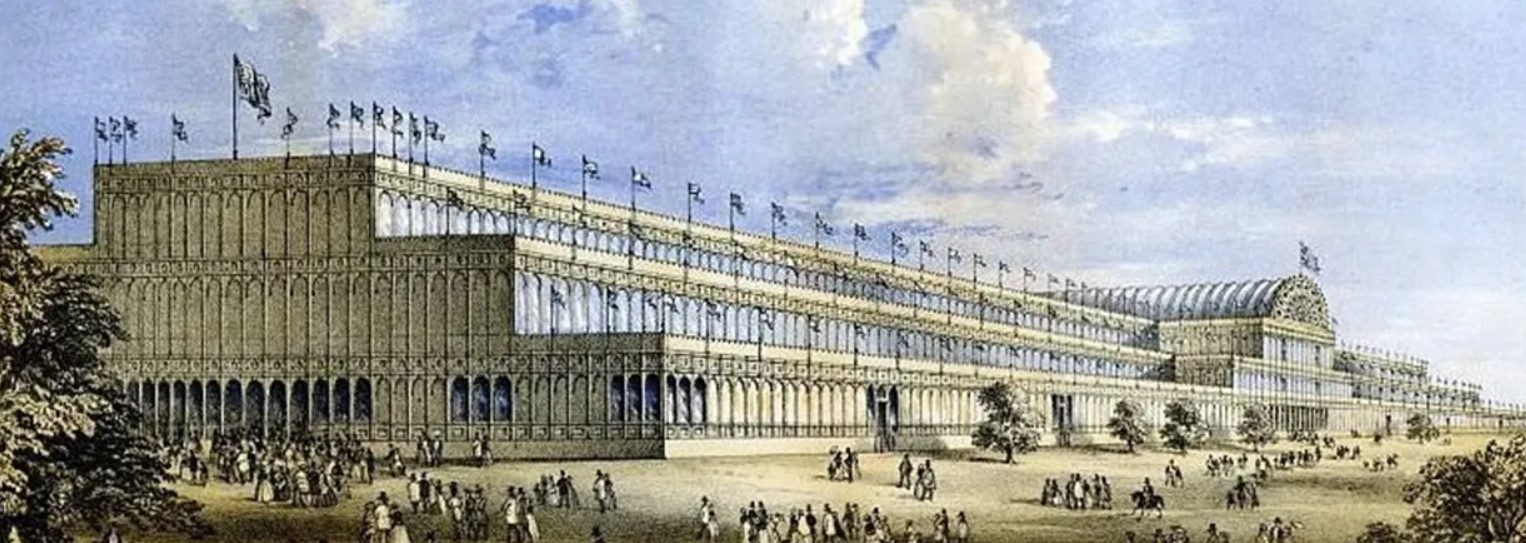
Are we to believe the histories offered to us?
A documentary has appeared, giving us fresh reason to question the official narrative concerning the Great Exhibition Building in Hyde Park, completed in May 1851and the first of many other such buildings. By way of reminder, we are looking at a building that, at 564 metres in length, surpassed the area occupied by five football fields, occupying a total surface area of 74,000 square metres. We learn that 300,000 panes of glass were used; that only 2,000 people worked on the building with the whole completed in a miraculous 9 months.
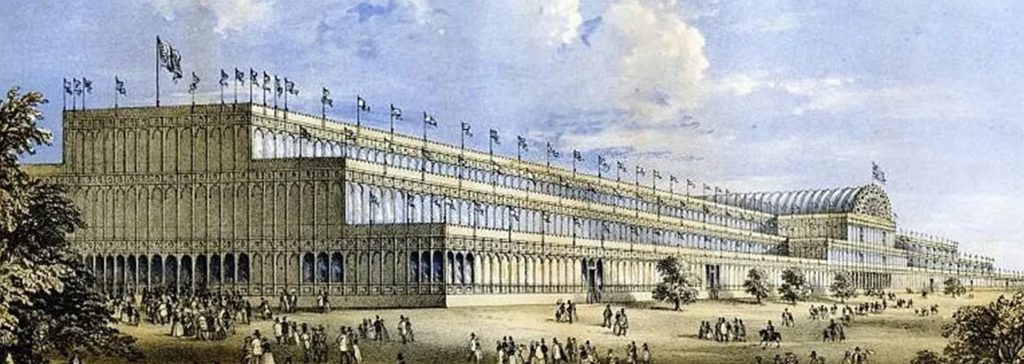
The documentary provides information that may be new to many, even long in the tooth hidden history sceptics. Were you aware for example that people inside crystal palaces like this one complained of headaches and nausea (see 31.40)? That the London Crystal Palace had an organ with 4,500 pipes, some of which were 10 metres in height? Independent evidence of the presence of this pipe organ exists and the documentary suggests a sinister motive concerning its possible effects on the up to 6 million visitors: it could produce hidden frequencies, so-called ‘infrasound’, with 3-7Hz affecting brain activity and suppressing critical thinking and enhancing susceptibility and 7Hz creating panic. The documentary described the materials used in the building’s creation – glass and metal – as perfect resonators, leading to the astounding claim that this building was broadcasting the frequency of subjugation.
Putting this into context Let us imagine that the magnificent Old World, with buildings radiating health and free energy, was systematically destroyed since at least the 11C (just look here at the number of fires that destroyed cities and cathedrals). Many of the buildings purportedly erected following these fires were said to have been erected in timeframes and by people that both defy credulity, making it likely that these ‘new’ buildings already existed and with the fire creating an opportunity to repurpose their histories.
Let us examine just a single example, that of the Bethlehem Royal Hospital in London. This was built. we are told, by Robert Hooke in just 3 years followng the Great Fire of London, 1666 but there are two possible problems with this. Firstly, Hooke was a scientist, not an architect, and he is moreover credited with building another edifice at the same time, that for the Royal College of Physicians. So, even just a modicum of critical thinking will show us that the official history cannot be correct.
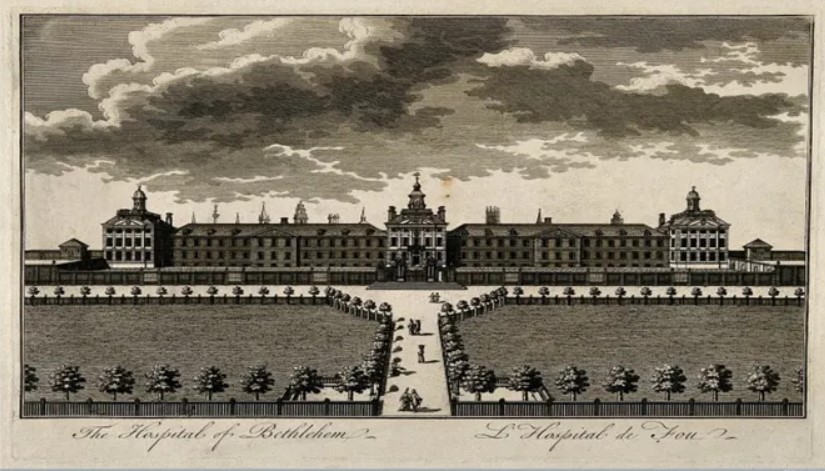
Bethlehem Royal Hospital, London (allegedly, 1674-6)
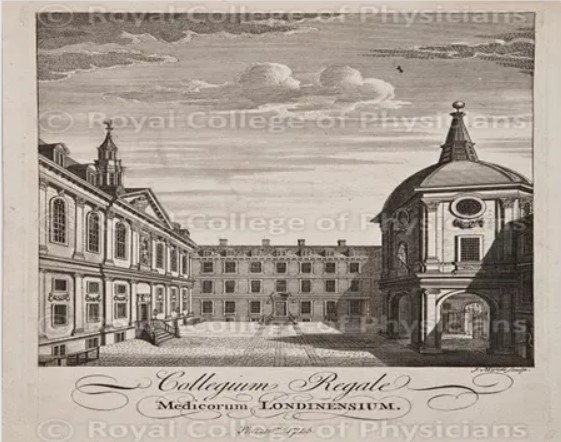
Royal College of Physicians: allegedly 1675
When therefore we are asked to believe that a gardener, Joseph Paxton, could design and construct the Great Exhibition Building in a mere nine months – or even just five months according to English Heritage that also describes the edifice as occupying the space of ten, not five football pitches – then we must throw up our hands in disbelief. This incredulity must extend also to the attribution of the Chatsworth Convervatory to Paxton, alongisde those at Hampton Court, Herefordshire, Capesthorne Hall, Cheshire, Holker Hall Cumbria, and Burton Close.
Here are some of the facts underpinning this litany of questioning, all having their origin in a Critical Thinking approach:
Chatsworth Conservatory According to Paxton’s granddaughter, Violet Markham, when built, the Chatsworth Conservatory was “ .…the largest glass building in the world” with “the quantity of sash bars required amount[ing] to 40 miles”. What is more, it required seven miles of underground heating pipes and one has to ask whether England in 1840, with the technology available to it then, would have been capable of creating this. As evidence, be aware that this marvel, described as the second finest building in the world in 1840 after St Peter’s Rome, was destroyed by dynamite in 1920 “….. because of difficulties in supplying the coal to heat it”, with this explanation coming from the Chatsworth website. With so much effort having gone into its constructionn supposedly recent times, would you really destroy it for these reasons?
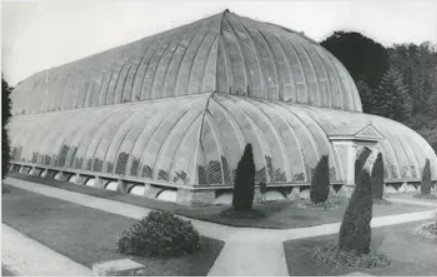
Could in fact the facts be re-arranged differently, and could this magnificent building, 84m long, 37m wide and 19m high, have been the creation of an older, more advanced civilisation? In that case, would the following photograph showing a number of men in front of it, give the misleading impression of having been brought into being by folk from the 19C? If nothing else, this photo will give you a sense of the immense size of this building that could, according to the Chatsworth site, allow two carriages to pass on the main thoroughfare:
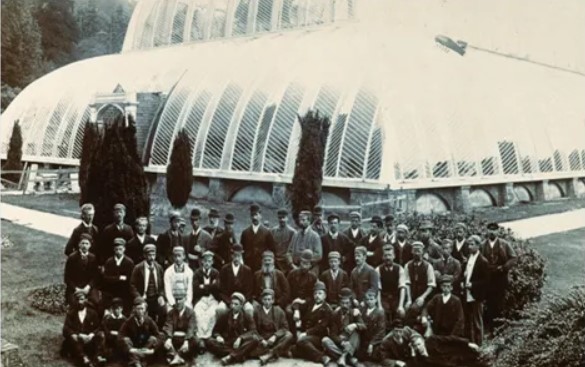
Note also that the stories used to explain the construction of the Great Exhibition building in London were presented to explain this great wonder of a building at Chatsworth So, in the talk that Violet Markham gave in 1950, she explained how the glass in the Chatsworth greenhouse came from “Chance of Birmingham”.
One is tempted to say that chance would be a fine thing given th number of questions that remain unanswered. How could a firm in 1851 have supplied 300,000 sheets of glass to London and before that to Chatsworth? And how credible is the process presented to us in which the technology was created by a French ‘inventor’ Georges Bontemps from a glassworks in Choisy-le-Roi (his invention having focused largely on creating coloured glass) using “a German process to produce finer quality and larger panes”. No details are provided as to how a man in France could have collaborated with people in Germany, or what technology was used in the 19C to create large panes of glass, or indeed how such an enormous number of glass sheets could were manufatured in Birmingham and subsequently transported to London.
And is it coincidence that the firm that English Heritage tells us supplied the iron frame, both for Chatsworth and the Great Exhibition building in Hyde Park, happened to be located in the same area outside Birmingham, Smethwick, as also the Chance Brothers who supplied (or so we are told) the glass?
Consevatories at Hampton Court, Herefordshire, Capesthorne Hall, Cheshire, Holker Hall Cumbria, and Burton Close Now, the conservatories at all these locations are attributed by Katherine Beale, in an article she wrote in Garden History, ‘A forgotten greenhouse by Joseph Paxton’, 2002, to Joseph Paxton. This is despite the fact, as she acknowledges at the start of her article, that: “‘The Hampton Court conservatory is a rare example of the private, domestic commissions that Paxton was permitted by the Duke of Devonshire to undertake, but of which, because of the loss of records, little evidence survives” (the italics are ours). In the absence of clear records, perhaps we should rethink the origin of these conservatories.
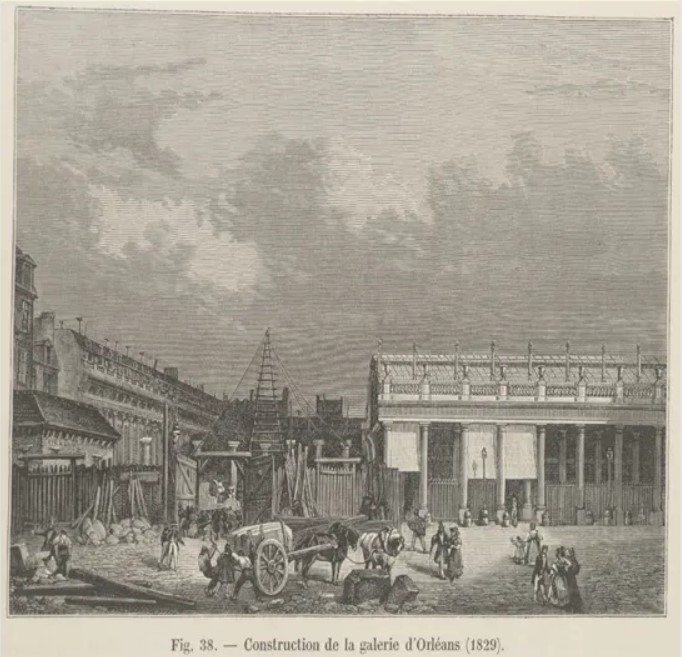
Not just these conservatories in fact. Beale quotes a number of glass constructions that provided models for Chatsworth and the Great Exhibition building in Hyde Park. One is la galerie d’Orléans in Paris, an arcade originally with an intricate roof, created, we are told, by Fontaine. Here is an image, apparently of it being constructed, and you might be asking whether the original building was really created in an era where the horse and cart shown in the illustration were the main conveyance:
What then of the Palm House at Kew Gardens, designed, allegedly, by Decimus Burton and constructed by Richard Turner in 1844. Official history reports that Burton was a consultant for Paxton’s conservatory at Chatsworth, and so we have one piece of official history supporting another, even if the first leaves one with innumerable unanswered questions. For starters, what was the source of Burton’s skill? You can read about this here and you might ask yourself whether it is such as to have equipped him with the necessary skills to design the Palm House and the other buildings attributed to him? Here is what we are told:
“His first training in the architectural profession was with his father, supplemented by lessons in drawing and draughtsmanship from George Maddox (1760-1843). In November 1817, he entered the Royal Academy Schools in London where he attended lectures given by John Soane (1753-1837), professor of architecture.”
Today, a training in architecture demands seven years of concentrated study followed by an equivalent number of years in an architect’s practice so are we really to believe that Burton had the requisite skills to design the magnificent Palm House?
We could ask the same of Turner’s involvement in the design of the Curvilinear Range in Dublin, allegedly in 1869:
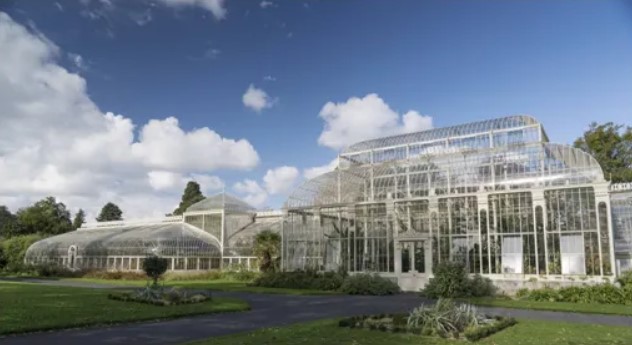
Curvilinear Range, Dublin
Finally, there is the Grand Palais in Paris which provided the inspiration, according to Beale. for Paxton’s work:
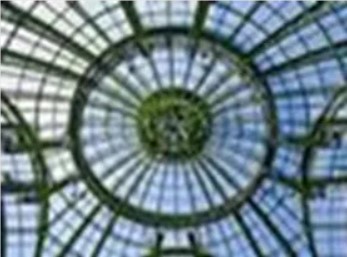
Grand Palais, glass roof vault (largest in Paris)
Conclusion Perhaps it is time to stop imagining that modern man – and all the names paraded before us, whether Paxton, Fontaine, Burton or Turner – are the creators of these wondrous buildings. With no disrespect to these men, is it time to accept that the buildings attributed to them may in fact have been the work of a magnificent Old World Order whose ideals and standards of Beauty we must seek to restore.
In this way, when a building such as the Crystal Palace, burns down (as it did in its new home in Sydenham in 1936), and when Churchill intoned that this blaze marked “The end of the Old World – and the beginning of the New World” we must stand firm. The building may have disappeared but its memory, and everything that it stands for, lives on in our memories and in other comparable buildings across the world. It is down to us to seek to restore the ideals of the Old World. , and with a new calendar year beckoning, this may be a good collective resolution.
What might we specifically be looking for ? On our wish list might be the restoration of free energy, a motor to societal improvement like no other, and of course a system of education rooted in debate and evidence-based Critical Thinking. Let the days when people’s opinions are brushed aside as those pertaining to a ‘denier’ (qua ‘vaccine denier’ and ‘climate denier’) be long gone. And of course the restoration of Beauty, and the marginalising, rather than exaltation, of the ugly in building and art.
There is a whole language in Old World buildings that speaks of kindness and empathy, that can be read in the rounded arches and rounded windows, so different from the sharp lines – squares and rectangles – of modernism. There is a long tradition that translates form into personality type, allowing us to reverse engineer the shapes in Old Buildings and reverse engineer the personalities of their creators. In this way, we can feel the character of the creators of Old World buildings that they have bequeathed to us.
The world would be an infinitely better place with people in charge with the caring characteristics that we can infer from these older buildings. So, we can seek to wish into being a world where the personality associated with squares and rectangles is given less prominence than that associated with gentler, more rounded shapes.