

…..and how to restore its lost Anglo-Saxon heritage
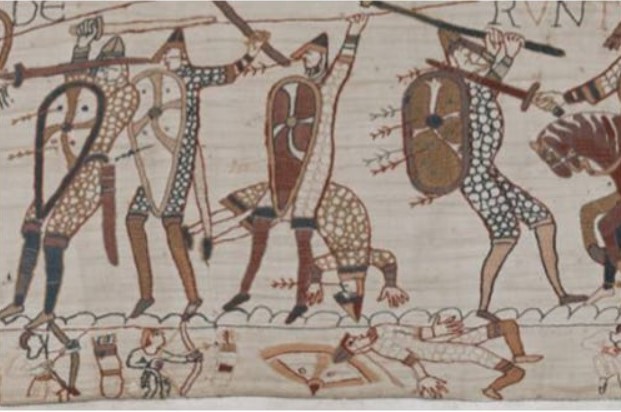
The Bayeux tapestry, ostensibly created in Canterbury, is back for the first time on British soil after over 900 years in France. It is exhibited in a once-in-a lifetime exhibition at the British Museum and depicts the Norman Conquest, an event described as ‘an origin story for England as we know it today’. This description implies that the invader, William Duke of Normandy, was responsible for a new chapter in England’s history, creating the England that we know today. The question facing us is whether the history and culture that preceded this is still alive in England and whether it lies dormant, awaiting rebirth, rather as Aurora in the Sleeping Beauty awoke after 100 years.
So, we could at a crossroads, living with the legacy of the Normans and with the spirit of the Anglo-Saxons waiting in the wings. So, let us look at the legacy of the Normans and whether Thomas Carlyle was correct in his view that England would have been nothing had it not been for the Norman Conquest. Or rather, whether Michael Wood, celebrated BBC historian, was right in perceiving the Conquest , not as a glorious event but as ‘the dismantling of a beautiful and rather archaic older civilisation by a younger and tougher one.’
Let us then look at the effects of the he Norman invasion which, as the British Museum has said, gave shape to modern Britain. After that, we will consider the legitimacy of William’s invasion and whether we have reached a point in life in Britain which is thirsting for a return to the norms that prevailed before William’s victory at Hastings.
The effects of the Conquest If we had to use a phrase to epitomise the strategy of William after the conquest, it would be ‘Rule by Iron Control’. A brilliant summary of how he operated is provided by the Professor of Medieval History, R.H.C. Davis, formerly Fellow of Merton College Oxford. In an article written in 1966, 900 years after the Battle of Hastings, he provided a damning account of what transpired after William assumed control.
Here is some of the shocking information that he provides: ‘As the result of one day’s fighting (14 October 1066), England received a new royal dynasty, a new aristocracy, a virtually new Church, a new art, a new architecture and a new language. By 1086, when Domesday Book was made, less than half-a-dozen of the 180 greater land-lords or tenants-in-chief were English. By 1090 only one of the 16 English bishoprics was held by an Englishman, and six of the sees had been moved from their historic centres to large towns.
He goes on to write that ‘By the end of the twelfth century almost every Anglo-Saxon cathedral and abbey had been pulled down and rebuilt in the Norman style. Nothing was allowed to stand which might remind the English of the glories of their past. ….they relegated the English language to the underworld of the lower classes. For almost two centuries the language of polite society—the aristocracy and the court—was French.’ (p.279).
There was more to come: ‘The Normans expropriated all the greater English landlords. Every village belonged to a ‘hundred’ which had a court every four weeks, and every ‘hundred’ belonged to a shire which twice a year held a court which all the principal men were compelled to attend.’ (p.280). So this was a strategy designed to weaken the power holding together these bottom-up institutions that empowered the People and put them in charge of the Justice system.
So, the expropriation of land was systematic , not just to break the structures that delivered power to the People but in order to reward a fighting force of men from N France, Brittany and Flanders. As Davis put it:’ Those who took part in it [the campaign] not only expected to be rewarded with land in England, but required it; and it was obviously impossible to satisfy them without expropriating large numbers of Englishmen’ (p.282). ‘The procedure was that anyone who was granted land by the king was given a sealed writ which stated the fact and had to be taken to the relevant shire court to be inspected and read out aloud. The theory was that the whole shire was thus made witness of the king’s grant, and would be held responsible for its execution; in this case it would have to inform the Norman what the lands of his predecessor were, and help them gain possession of them’.
Not surprisingly, Davis refers to ‘ruthless spoliation’ (p. 286) and how William used the efficient Anglo-Saxon machinery of government to expropriate the English, completing their top-down control by building castles in the chief towns of ‘nearly all shires’ (p.284).
So, there can be in no doubt that the strategy was a ruthless top-down imposition of control, creating huge casualties. No wonder that the Anglo-Saxon chronicler wrote that: ‘they oppressed the poor people by building castles everywhere.’ Not only that, but the chronicler Simeon of Durham ells the tale of the Northumbrians reduced to selling their children into slavery: ‘They were left to eat rats and grass.’
The horrors did not end there. Hope for advancement must have been wiped out by the Normans’ policy of making nepotistic appointments. A case in point is that of William’s half-brother, Odo of Bayeux who, after William, he was the largest landowner in the country, being endowed with profitable land in both the east and in the south where he became Earl of Kent.
Construction of castles and towers throughout the land – using Saxon forced labour – became a top priority. Odo systematically terrorized the English into submission and he became a symbol of oppression and brutality. He also used his authority to selectively reward other noblemen with land and privileges, establishing a solid body of followers. He also owned c.350 manors in eleven other counties. His properties brought him £3000 per year. The Domesday Book census commissioned by William in 1086 identifies Odo as the realm’s wealthiest tenant-in-chief.
The nepotism underpinning his ascendancy is a peculiarly Norman import. For, in 1049, whilst still a teenager, Odo was appointed by William as Bishop of Bayeux, a flagrantly political move since Bayeux ranked as the senior and most prestigious of the seven Norman bishoprics and Odo was was well below the officially required age of thirty for episcopal appointments. The logic? Having Odo in high clerical office bolstered ecclesiastical support for the Duke, and simultaneously put Odo in a position to keep the rebellious barons around Bayeux in line.
A medieval source, Orderic Vitalis, wrote of him that: 2The character of this prelate (…) was a compound of vices and virtues; but he was more occupied with worldly affairs than in the exercise of spiritual graces. The monasteries of the saints make great complaints of the injuries they received at the hands of Odo, who, with violence and injustice, robbed them of the funds with which the English had piously endowed them in ancient times’ (Orderic Vitalis, Book 4, Chapter 3, p. 50).
The fact that William and Odo’s maternal grandfather was a mortician may have added salt to the wound. We know from the chronicler William of Jumieges that Duke William was insulted by inhabitants of Alencon in 1051-2 for having a maternal grandfather that dealt with pelts – and they beat pelts and furs in order to insult the duke and despisingly called him ‘pelliciarius’, a person who deals with skins. In retribution, William ordered that his mockers should have their hands and feet cut and his harsh reaction may have been to the suggestion that his grandfather was in fact a mortician.
Could this really be correct? In fact, a Cambridge don, Elizabeth Van Houts, argued in 1986 that the intended insult was that he was descended from a ‘pollincotor’, a man who prepares corpses for burial. The beating of animal pelts (rather than human skins) was the closest that the inhabitants could get to expressing their thoughts. The fact that the grandfather held the position of chamberlain, a post that included the preparation of bodies for burial. This evidence leads her to conclude that ‘It is time to forget the story of the tanner. Herleva’s father, William the Conqueror’s maternal grandfather, had prepared corpses for burial and later became the duke’s chamberlain.” (p.404).
All rather dark, adding to the darkness surrounding the devastating acts that William instigated in England. One video commentator has tantalisingly suggested that the Normans went into battle carrying a banner representing Lucifer, the light giver – a round sun with surrounding curvy lines that are not representative of the cross (see image below) – and we leave it to the reader to determine whether this is the case or not, and whether this helps explain the Norman barbarity.
Features of Anglo-Saxon society that were lost The invasion put a brutal halt to the flourishing of Anglo-Saxon England. This was a society in which the earliest beginnings of english common law began, alongside trial by jury, property and contract law. Shire hundreds courts made up of a hundred households met monthly to handle minor legal cases, independently of royal courts. Local noblemen had the decisive say in verdicts produced in the more powerful shire courts.
Then, Anglo-Saxon kings were technically elected from amongst the leading families (aethelingas) by the wise body of wealthy powerful men (the witan), at least until Alfred when it became more strongly based on a named heir. It was not just the selection of the monarch that differed from later practice but their function too. According to one account, ‘Kings could not, except in exceptional circumstances, make new laws. Their role instead was to uphold and clarify previous custom. The first act of a conquering king was often to assure his subjects that he would uphold their ancient privileges, laws, and customs.’
The rights of women were stronger than subsequently too. The same account states that:
‘A woman could own property in her own right. She could and did rule a kingdom if her husband died. She could not be married without her consent and any personal goods, including lands, that she brought into a marriage remained her own property. If she were injured or abused in her marriage her relatives were expected to look after her interests.’
Then, power was not centralised in the way that it became under the Normans, with a single governmental unit exercising sway over the whole of England. Before the conquest, power was more diffuse and it was only from 850AD, that power was consolidated into the three large Anglo-Saxon kingdoms of Northumbria, Mercia, and Wessex.
Putting power and control to one side, there is also the matter of the Anglo-Saxon sense of humour. Here is a riddle from the 9C where we are invited to identify the object described: :
A strange thing hangs by a man’s thigh,
hidden by a garment. It has a hole
in its head. It is still and strong
and its firm bearing reaps a reward.
When the man hitches his clothing high
above his knee, he wants the head
of that hanging thing to poke the old hole
(of fitting length) it has often filled before.
~ Exeter Riddle #44
[The answer is a key]
So, the Saxon culture was an expensive and empowering one and its suppression by the conquering Normans prompts the all-important question as to whether their invasion was legitimate or not. This is the focus of our final section.
Was the invasion justified? The Bayeux tapestry, described in one set of reflections as ‘an unapologetically propagandistic account justifying William’s conquest’, justifies the conquest on the grounds that King Edward the Confessor promised the kingdom to William . Not just that but Harold, shipwrecked and capture in Normandy and rescued by William, swore allegiance to support William and his claim to the English crown, wsearin on relics. When then the Witan elected Harold, and he took the crown in 1066, William regarded this as direct treachery by a vassal, and used the broken reliquary oath to win Papal backing.
Harold’s defence, voiced by famed historianEdward A. Freeman, insisted that the cause of King Harold, last of the Anglo-Saxon rulers of England, had been the just. Viewing the Norman Conquest as a tragic interruption of natural English democratic development, he believed that the justice of Harold’s cause rested on six key political and constitutional arguments. These were: a. The Right of Constitutional Election (The Witenagemot) For Freeman, the ultimate source of political legitimacy in early England was the Witenagemot (the council of English nobles and bishops). Freeman stressed that Harold was democratically chosen by the Witan. In his view, the English crown was elective, not purely hereditary. Because the national council unanimously selected Harold to safeguard the realm, his right to rule was absolute. b. The Invalidity of Foreign Oaths and Promises Norman propaganda heavily relied on the claim that Edward the Confessor had promised William the throne, and that Harold had sworn a sacred oath to support Duke William’s claim. c.The Crown Was Not a Gift: Freeman argued that Edward the Confessor had no legal right to “bequeath” or promise the English crown to a Norman duke without the explicit consent of the Witan. d.Coerced Oaths: Freeman maintained that any oath Harold swore to William while shipwrecked in Normandy was extracted under duress. More importantly, a personal oath could never override Harold’s higher constitutional duty to the English people who elected him e.Edward the Confessor’s Deathbed Bequest Even looking at the feudal logic of successions, Freeman pointed out that on his deathbed, Edward the Confessor explicitly named Harold as his successor. Under Germanic custom, a king’s dying wish carried immense weight. Because Edward ultimately chose Harold, and the Witan immediately ratified it, William’s legal claim was entirely hollow f. Harold as the Champion of Teutonic Liberty On a philosophical level, Freeman saw Harold as the ultimate defender of native “Teutonic” (Anglo-Saxon) freedom against foreign, Romanised tyranny. By fighting at the Battle of Hastings, Harold wasn’t just defending his title; he was defending the ancient laws, language, and independent spirit of the English people against an illegal invasion.
Time to wake up from the effects of an illegal invasion Freeman produces compelling arguments to counter those presented in the propagandistic, Bayeux Tapestry. Now, with the tapestry (or rather embroidery) returned to British soil, it is time to take stock. Do we want the top-down, High Power Distant style imported by the Normans? Does this sit well in a country with Anglo-Saxon traditions of bottom-up democracy?
Signs that people are angry with the top-down system are abundant. On 16 September, a Referendum in the village of Piddington, voted to leave the UK. Alongside this, a Peoples Court has been established under Natural Common Law – a higher jurisdiction than the Corporatised court system in the UK – and this will be hearing cases again on 14 October. This is to revive the people-run system of Hundreds Courts and Shire Courts that operated before the Norman invasion. The monarch swore in his Coronation oath to main the ‘laws and customs’ of this country, and so, since the Coronation Oath is a legal document, the jurisdiction of a Natural Common Law Court is constitutionally valid.
Incidentally, if you are interested in taking part in this important development , then just email this email: ContactPeoplesCourt@proton.me for information.
The evil fairy in the Sleeping Beauty inflicted a curse on the princess her from which in time – in her case 100 years – she recovered. In England’s case, now just 40 years short of 1000 years – we can restore what was there before the invasion, namely a society based on bottom-up control. The spell of top-down control has been broken.
