

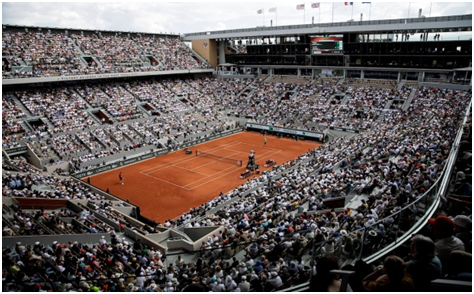
With strawberries and cream and glass of bubbly in hand, I settled in for the semi-final match of the men’s French Open on Friday 5 June.What followed triggers vital questions.
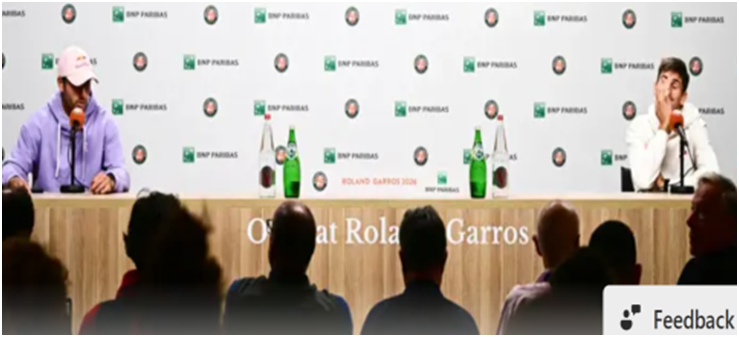
Less than half an hour before fellow Italians, Matteo Arnaldi (104th ranked), and Flavio Cobolli (10th seed) were to play in the semi-final of the French Open, it was announced that Arnaldi had to withdraw due to an ‘unspecified viral illness’. The BBC, reporting on the news conference announcement, stated that ‘In order to avoid Cobolli getting ill, the pair cautiously sat at opposite ends of the interview table”. Indeed, they were sitting 3 metres apart to avoid the risk of infection. The semi-final singles prize at the French Open is €690,000 and Arnaldi will have pocketed that since he had earned his place in the quarter-final.
The question really concerns Arnaldi’s ‘unspecified viral illness’ that prevented him from competing in the final where the prize money on the table is an eye-watering €1,275,000 for the runner-up, and €2,550,000 for the winner. In the event, the first went to Cobolli (10th seed) and the second to Alexander Zverev (world number 3).
It is true that, to reach the semi-final, Arnaldi spent 17 hours and 42 minutes on court through four matches, one hour and 58 minutes longer than any other player has taken to make the quarter-finals at any Grand Slam tournament since the ATP Tour began recording match times in 1991. So, he spent longer on the court to reach the quarter finals than anyone in tennis history but it did not affect his sense of well-being. He actually said ‘I was feeling actually very good’ and that he was ’feeling okay’ during practice on Thursday. It was only after dinner and a visit from the doctor that his symptoms arose – vomiting, dizziness and difficulty standing up. All this has been put down, not to food poisoning – which you might have expected since the problems started after dinner – but to ‘an unspecified viral illness’. To those of us attuned to reading about viruses, bells might have been ringing, particularly following a close scan of the book The Contagion Myth (2020) by Thomas Cowan MD and Sally Fallon Morrell. What follows are some of the most striking points from this book, freely available online.
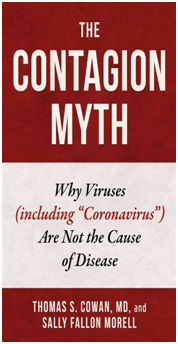
The Contagion Myth: holding no punches Cowan begins by boldly asserting that he ‘knew for decades that ‘the virus king is naked’. He and his co-author then flesh out this idea in relation to the work of Louis Pasteur – the cornerstone of germ theory – and Stefan Lanka who countered it. The book’s words cannot be improved upon so here are some of the astonishing assertions made in this book.
Pasteur: the promoter of germ theory Of him, the book makes the following shocking statements, reproduced here in full: ‘Pasteur claimed to find a listeria bacteria in the milk of cows and attributed the death of people fed the milk to this. Perhaps, however, the bacteria were presented as a consequence of toxins in the body. “Isn’t it possible that toxins in the milk—possibly because the cow is not well nourished and cannot easily get rid of the toxins— account for the presence of listeria (which is always present in our a bodies, along with billions of other bacteria and particles called viruses)? The listeria is simply biodegrading the toxins that proliferate due to the unhealthy condition of the milk.’
The Contagion Myth continues by discussing the secret and all-important notebooks that Pasteur did not reveal in his lifetime: ‘Pasteur passed his laboratory notebooks along to his heirs with the provision that they never made the notebooks public. However, his grandson, Louis Pasteur Vallery-Radot, who apparently didn’t care for Pasteur much, donated the notebooks to the French national library, which published them. In 1914, Professor Gerard Geison of Princeton University published an analysis of these notebooks, which revealed that Pasteur had committed massive fraud in all his studies. For instance, when he said that he injected virulent anthrax spores into vaccinated and unvaccinated animals, he could trumpet the fact that the unvaccinated animals died, but that was because he also injected the unvaccinated animals with poisons.’
To dispel any doubts as to the way the public had been misled, Cowan and Morrell state that: ‘In the notebooks, Pasteur states unequivocally that he was unable to transfer disease with a pure culture of bacteria (he obviously wasn’t able to purify viruses at that time.) In fact, the only way he could transfer disease was to either insert the whole infected tissue into another animal (he would sometimes inject ground-up brains of an animal into the brain of another animal to “prove” contagion) or resort to adding poisons to his culture, which he knew would cause the symptoms in the recipients.’
Cowan and Morrell end this section with Pasteur’s admission that the whole effort to prove contagion was a failure, leading to his famous deathbed confession: “The germ is nothing; the terrain is everything.” As they point out, the ‘terrain’ in this case refers to the condition of the animal or person and whether the animal or person had been subject to poison.
To hammer the point home, the authors point out that ‘since Pasteur’s day, no one has demonstrated experimentally the transmissibility of disease with pure cultures of bacteria or viruses.’
As if this is not all shocking enough, leaving the notion of infection and viruses in tatters, The Contagion Myth also discusses the work of German biologist, Dr Stefan Lanka.
Stefan Lanka It was while working on his PhD thesis on sea algae that Lanka realised that those working in the field of modern virology were never, according to the book, ‘isolating, purifying, or properly characterizing “viruses” but instead confusing what they were finding with artifacts made by their propagation techniques’. He therefore naturally questioned whether the viruses that supposedly were causing disease even existed. ‘His question was not so much about whether viruses are infectious entities, but something even more fundamental—whether these viruses even exist at all.’
Bringing Covid into the frame Extrapolating to Covid, Cowan and Morrell make the shocking assertion that the authorities ‘never purify any virus from the sick people; …..never demonstrate the absence of the virus from well people; …..never show that the transmission of purified virus could make well people become sick. This is scientific fraud of the first order. ‘
Returning to the world of tennis Fresh with this information from Cowan and Morrell, what are we to make of the announcement that an ‘unspecified viral illness’ was the factor behind the debilitating symptoms that affected Arnaldi, forcing him to withdraw from the quarter finals in Paris, the city that gave birth to Pasteur? Do readers go along with this, or do you suspect some other cause? According to an article in Forbes, match-fixing is common in tennis but is it a step too far to consider that something as egregious as this could be taking place at the French Open? Please readers, offer your thoughts in the comments as to whether this is possible or not, and what the likely motive might be (and on whose part??). Then, consider again the news conference at which Arnaldi and Cobolli were seated 3m apart from each other, in the words of the BBC to ‘avoid the risk of infection’ and with the logo of the event’s official sponsor, BNP Paribas, emblazoned repeatedly on the wall behind them. Do you agree with the BBC’s presumption that proximity gives rise to infection, and if not, perhaps you could share this piece and seek the views of others. It is vital to know whether confidence in grand slam competitions is warranted as well as whether the mainstream media are complicit in spreading what Cowan and Morrell describe as The Contagion Myth.
Armed with answers, we could select the most appropriate occasion on which to indulge in strawberries and cream, and a celebratory bubbly. Would we be toasting a Grand Slam Tennis Tournament win, or the latest disclosures regarding the failures of virology?
